
SEA Plastics: heading for the Mediterranean for its 10th expedition
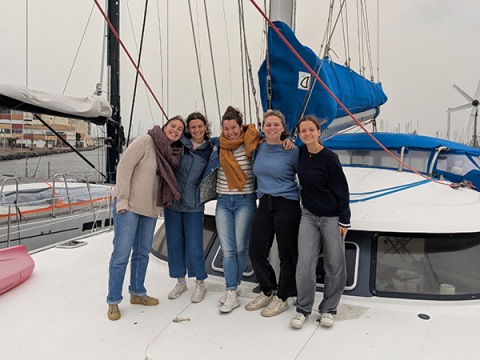
April 15 2026From April to July 2026, Joanne, an AgroParisTech student on a gap year, is taking part in the 10th expedition organized by the SEA Plastics association. Joined by Cassie, Mathilde, Marion, and Léna—students at Centrale Lyon, the University of the Antilles, the École Pratique des Hautes Études, and the Institut Agro Montpellier—they will spend four months aboard a sailboat collecting scientific data on plastic pollution and raising awareness among local communities. Meet a team ready to do whatever it takes for our oceans.
Can you tell us about the SEA Plastics project? What is its purpose and what are its objectives?
Joanne Etchanchu: SEA Plastics stands for Simon, Ernest, and Aymeric—three students from AgroParisTech who had a somewhat crazy idea ten years ago: to take action against plastic pollution in the Mediterranean by refurbishing a boat purchased by the association. The first teams wanted to test protocols for scientists and raise awareness in harbours and schools, and over time the project took shape to effectively combat this pollution. Since then, the SEA Plastics vessel has been sold, but every year, 4 to 5 students set out on an expedition during the spring and summer, usually during their gap year before their final year at school.
This year marks the tenth expedition: we will spend four months in the Mediterranean, particularly along the French, Spanish, and Italian coasts. During our days at sea, we collect samples to support scientific research on plastic pollution. During our stops, we visit local schools and organizations to raise public awareness about the challenges of plastic pollution and the actions people can take to stem the tide.
What made you decide to embark on this journey with SEA Plastics?
Joanne Etchanchu: Plastic pollution is a problem that is both visible and invisible. You only need to spend a little time at sea to see it for yourself. Having grown up near the ocean myself, preserving our oceans is a cause close to my heart. I also find SEA Plastics’ dual mission particularly compelling as an approach to the pollution problem, and being able to live out my commitment on a sailboat is an extraordinary opportunity for me!
How are you preparing for this expedition? What will it be like?
Joanne Etchanchu: Our crew came together last summer, and since then, a solid organizational structure has been established. Every year, the new team has to find a boat, scientific partners, funding, the itinerary, the skipper who will accompany us on our mission, the schools we want to visit, and many other details. We’re not starting from scratch, but it’s almost like it. This year we’re setting sail in early April from Cap d’Agde, returning on July 31 to Saint-Raphaël. Our expedition is divided into two parts, as our first boat isn’t available for the entire two-month summer period. First aboard the Tarpon, along the French and Spanish coasts, then aboard the Aotearoa heading toward the Italian, Corsican, and Sardinian coasts.
En tant qu'étudiantes venant de formations et établissements différents, qu'espérez-vous apporter personnellement au projet ?
Marion Durand: With our diverse backgrounds (engineering, agronomy, ecology), we bring complementary perspectives to the project to tackle plastic pollution. As an ecologist, I can help observe and understand the impacts of plastics on marine and terrestrial ecosystems, while sharing this perspective with the public. Our strength lies in this diversity: each discipline helps us better understand the issues and raise awareness in different ways. For example, explaining the consequences of microplastics on biodiversity or proposing technical solutions to reduce their impact. Together, we can make the project more comprehensive and accessible to everyone.
Do you have any particular concerns before departure?
Joanne Etchanchu: I hear that seasickness is inevitable when you spend so much time on a sailboat. I don’t usually get it, but I hope I’ll be spared over the next few months!
Léna Clochard: I’d say the same as Joanne—seasickness—but for now, I can’t wait for us to set sail and for the adventure we’ve been planning for over eight months to finally happen! There will surely be some tougher moments than others on the boat, but we’ll cross that bridge when we come to it!
Mathilde Le Dizès: Four months on a sailboat with a packed schedule—it’s going to be intense! There will surely be some fatigue and a few tougher moments, but we’re a great team and we’ll handle it. Honestly, I’m just really looking forward to getting started!
Any final words for students who are hesitant to give it a try?
Marion Durand: Getting involved in a community project as a student can be daunting—due to a lack of time or the need to commit… But the personal growth, learning, and sharing that come from this experience are definitely worth it! Working with other passionate young people boosts motivation and lets us learn together how to build a project from the ground up. With SEA Plastics, this project allows us to take a (big) step into the world of research and science outreach—it’s incredibly valuable! But above all, setting sail to visit schools, organizations, and associations helps us build a large network around a topic that’s close to our hearts.
A call for support
To fund this public-interest expedition, the SEA Plastics 2026 team needs your help. Every contribution helps cover the costs of navigation, scientific equipment, and educational outreach. By supporting SEA Plastics, you are investing directly in citizen science and environmental education for the younger generations in the Mediterranean.