

ParisBiotek, a biosensor capable of detecting Parkinson's disease
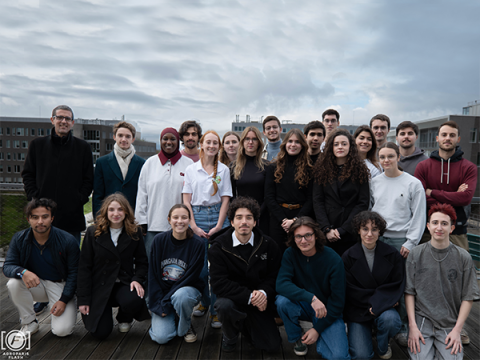
January 20 2026Twenty-four students from AgroParisTech, ENS Paris-Saclay, and École Polytechnique are currently working on designing a biosensor capable of detecting and quantifying a biomarker for Parkinson’s disease: L-dopa, as part of the SensUs competition. This student innovation opens up new prospects for the therapeutic monitoring of people with Parkinson’s disease. We meet Erine Faucret, a student at AgroParisTech and president of the ParisBiotek association.
An international competition to stimulate innovation
The adventure began while participating in SensUs, an international competition dedicated to the development of innovative biosensors. Every year, this Dutch competition challenges teams from around the world to design a biosensor capable of detecting a molecule of interest related to a public health issue. In 2024, the ParisBiotek team had already made a name for itself with AgroSens, a creatinine sensor for monitoring kidney failure. This year, under the leadership of Erine Faucret, the team is tackling a new challenge: developing a biosensor capable of detecting and quantifying L-dopa, a key biomarker for Parkinson’s disease. Fifteen students from the team will travel to the Netherlands from August 24 to 27 for the competition.
What problem are you addressing with this sensor?
E.F.: SensUs is an annual international competition dedicated to sensors for healthcare. This year, the competition challenges us to develop a biosensor capable of detecting and quantifying L-dopa, a biomarker for Parkinson’s disease. There are two aspects to the problem: on the one hand, there is a scientific and technical challenge, as this molecule is difficult to detect accurately; on the other hand, there is a public health challenge, as such a sensor could improve medical monitoring of patients with the disease.
What makes the detection of this biomarker particularly innovative or complex?
E.F.: L-dopa (levopoda) is an essential molecule in the treatment and monitoring of Parkinson’s disease. Detecting it is complex because it is found in very low concentrations in biological fluids and coexists with other compounds of similar structure, which complicates the specificity of measurements. Our goal is to design a biosensor that is sensitive, fast, and selective, capable of accurately quantifying L-dopa under conditions close to real life, with a view to eventual practical application.
How could this sensor improve patient care?
E.F.: Today, the diagnosis of Parkinson’s disease is based mainly on clinical observation of motor symptoms, which often appear late in the disease. Our biosensor could contribute to more objective and early monitoring. Specifically, it would allow for better tracking of treatment effectiveness and personalized adjustment of L-dopa doses. In the longer term, this could improve patients’ quality of life, reduce side effects, and optimize medical care.
How did you organize the work within the team?
E.F.: Our team of 24 students from AgroParisTech, ENS Paris-Saclay, and École Polytechnique is divided into five areas: experimental for the biological part, microfluidics for device design, electronics for technical development, entrepreneurship for strategy and partnerships, and communication for social media. Although each group has its own specific tasks, we meet regularly every week to coordinate our progress. We are also fortunate to be supported by several supervisors and researchers, including Vincent Sauveplane, a lecturer and researcher at Micalis and our main supervisor, Jean-Frédéric Audibert and Rasta Ghasemi, researchers at ENS Paris-Saclay, Kevin Lachin for microfluidics, and François Mavré for electrochemistry. We are also fortunate to have the financial support of the AgroParisTech Student Union and The Bench. We would like to express our sincere gratitude to all of them for their help and support!
What are your plans for this project going forward?
E.F.: Currently, we are focusing on designing our biosensor and seeking funding. Subsequently, if certain members wish to continue, the project could become a promising initiative. We could then optimize the biosensor to improve its sensitivity and robustness, and then promote our work through scientific publications or collaborations with research laboratories.
A message for students who are hesitant to embark on this adventure?
E.F.: For students who are interested in biotechnology and want to put their skills or free time to good use in a dynamic and demanding association, this is an ideal opportunity! It is also a unique opportunity to collaborate with researchers, teacher-researchers, engineers, and stakeholders in the health sector. Participating in a project like this means stepping outside the academic setting, learning as part of a team, and developing practical skills that you don’t always find in the classroom. Even if the challenge may seem ambitious, it is an extremely rewarding experience, scientifically, personally, and collectively.