
Clim’Ag’Rica: Three students set out to document agricultural adaptation in Costa Rica
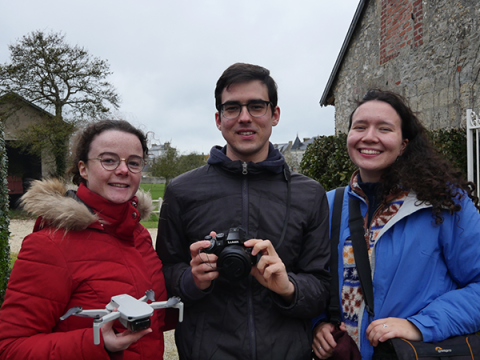
April 02 2026Starting Tuesday, April 7, and for a period of three months, Alexis, Solène, and Agathe—agronomy and agri-food students at AgroParisTech currently on a gap year—are heading to Costa Rica as part of the Clim’Ag’Rica project with the student association Clim’Adapt. Their mission: to document on the ground agricultural practices for adapting to climate change, from small coffee producers to pineapple and banana cooperatives. Supported by the AgroParisTech Foundation and in collaboration with researchers from CIRAD, they will produce a documentary film, articles, and awareness-raising tools to show that there is still time to act. Meet this student team.
You’re heading to Costa Rica for three months to document agricultural projects addressing climate change. What inspired you to do this projet during your gap year?
A.G.: The three of us wanted to use our gap year to get out into the field and do our part to propose concrete solutions to climate change. Today, climate change can no longer be denied. This reality is frightening, and rather than remaining paralyzed by it—a feeling shared by 70% of 16- to 25-year-olds who say they are very concerned (The Lancet Planetary Health, 2021)—we chose to build a project that offers hope. Our goal is to show that it is possible to adapt to these new climatic conditions by documenting the practices of those who are already doing so. This project brings together what unites us: a shared interest in sustainable agriculture, a desire to contribute to concrete solutions, and a strong openness to the world.
Why Costa Rica, and why focus on agriculture? What makes this country unique when it comes to agricultural climate adaptation?
S.A.: Costa Rica is often seen as a pioneer in environmental conservation: 26% of the country is covered by national parks, 99% of its electricity comes from renewable sources, and reforestation campaigns have been underway since the 1990s. But when it comes to agriculture, the reality is more mixed: extensive monocultures, high pesticide use… It is this ambivalence that we want to explore. As the world’s leading exporter of pineapples and the fourth-largest exporter of bananas, Costa Rica is also one of the countries most vulnerable to climate change. It is part of the V20 (list of the 20 countries most vulnerable to climate change), facing increasing floods and droughts, as well as declining coffee crop yields. This context makes the study of adaptation projects particularly relevant and urgent.
You’ll be working with a wide range of stakeholders—from the UNDP to farmers, including the AFD and CIRAD. How will you bring all these different perspectives together to create a coherent whole?
S.A.: By engaging with a wide range of stakeholders—from all levels of the supply chains up to the political level—our goal is to provide complementary perspectives on shared issues. Organizations such as government ministries or the United Nations Development Programme (UNDP) set national policy directions, which are adapted locally by technical institutes and researchers—who also play a key role in relaying information from the field—and funded by entities such as the French Development Agency (AFD). Cooperatives and farmers, meanwhile, are on the front lines. Even though these actors may seem to be working on distinct issues, in reality all the building blocks of the system are interconnected. As future engineers, bringing these perspectives together to gain a systemic view is at the heart of our approach. Certain issues, such as water management or pest control, particularly illustrate this cross-cutting nature: the various stakeholders will most likely converge on these topics, highlighting the most critical areas on which to focus adaptation efforts.
You work with researchers from CIRAD while also producing a documentary film, newsletters, and climate murals for children. How do you balance scientific rigor with accessibility for the general public?
A.G.: That is precisely why we use different formats. We collaborate with researchers from CIRAD to conduct surveys among producers and produce rigorous documentation on the supply chains. The documentary film, on the other hand, is intended to be accessible to a general audience: it makes complex topics understandable by focusing on products that everyone consumes on a daily basis—pineapples, bananas, coffee, and cocoa. In addition, we’ll provide detailed coverage of each project we encounter through an article available on our website, with a more scientific and technical focus. Finally, we lead workshops using La Fresque du Climat, an educational tool already used by over 2.3 million people worldwide, which we tested with a fifth-grade class and found to be a real success!
A call for support
To carry out this field project, Alexis, Solène, and Agathe are appealing to the generosity of the AgroParisTech community and beyond through a tax-deductible fundraising campaign. Your financial support will enable them to carry out this project in support of agricultural transition and the fight against climate change.
You can also follow their adventure on Clim’Adapt’s social media channels (LinkedIn, Instagram, Facebook).