

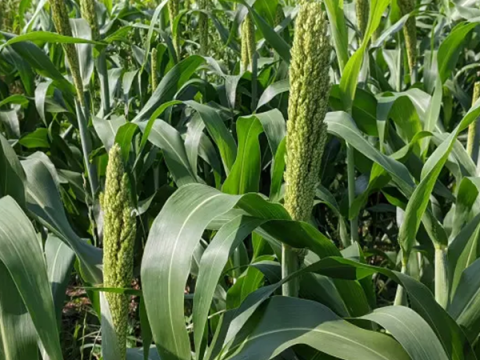
Sorghum production boosted by climate change
October 12 2026A study carried out jointly by AgroParisTech and INRAE and published in the journal Earth’s Future projects that global warming will have an overall positive impact on sorghum yields in Europe. The production of this cereal, which is a good alternative to maize for animal feed, is compatible with limited water resources and high temperatures. Using simulations based on past and future climate data, the scientists are paving the way for new strategies to adapt European agriculture.
Rethinking the role of sorghum cultivation in Europe
With this year’s corn harvests in the European Union estimated to be at their lowest level, it is time to rethink the role of this cereal crop. Corn is now a mainstay of animal feed, and its yields are highly dependent on water availability. Sorghum is generally considered a good alternative to corn due to its resilience to high temperatures and water scarcity. This crop is frequently grown in arid regions, with approximately 47% of global production in Africa and 17% in the United States. In light of the risks of extreme heat and water scarcity associated with climate change in Europe, researchers emphasize the importance of assessing sorghum’s production potential in this region of the world, where the crop remains, for now, marginal. It is estimated to account for 0.1% of Europe’s agricultural land. The potential for producing sorghum-based animal feed had not yet been assessed on a pan-European scale and remains poorly understood in the context of climate change.
Sorghum production in the face of climate change
Scientists have shown that, on a European scale, climate change will have an overall positive impact on sorghum yields, though with regional variations: yields are expected to increase in northern Europe and decrease slightly in the south. Depending on the climate change scenario considered, the projected overall average sorghum yield is expected to rise from 3 t/ha under current climate conditions to an average of between 3.4 and 3.8 t/ha by 2050–2100. Geographic areas combining high and stable yields could increase from 22% of Europe’s cultivated land under current climate conditions to a range of 29% to 34% by the end of the century. Thus, the results of this study estimate that sorghum production could replace nearly 90% of the corn currently used for European animal feed, if it were grown once every three years. This crop appears to be a fairly robust alternative under conditions of high temperatures and low water availability, compared to corn, which is more frequently irrigated (38% of irrigated farmland in France today is used for corn).
Using historical data to look toward the future
As part of this research, scientists developed a machine learning model capable of predicting grain sorghum yields based on key climate parameters (humidity, temperature, precipitation, etc.). The model was trained using historical data on sorghum yields and then combined with climate variables to generate projections for two target future periods: the middle and end of the 21st century. To do this, the authors considered 20 climate change scenarios, which were generated using five climate models, allowing them to draw robust conclusions about sorghum’s production potential. The results indicate that sorghum represents an attractive option for adapting European agriculture to climate change. More locally, at the national level, sorghum production and its use in animal feed present significant challenges, particularly regarding water management. The water saved by growing sorghum could thus be allocated to other crops, in order to increase the country’s food self-sufficiency.