

Businesses and biodiversity: AgroParisTech contributes to a global report
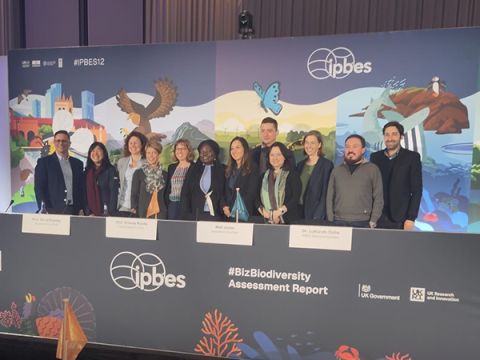
March 30 2026Adopted in February 2026 following the 12th IPBES plenary session in Manchester, the “Business and Biodiversity” report is the first global scientific assessment of the links between economic activity and biodiversity loss. Clément Feger, an associate professor at AgroParisTech, contributed to the report for over four years, first as an expert for the scoping study and then as a Lead Author. A look back at a report set to transform the practices of businesses and governments.
IPBES, a scientific body serving policymakers
Established in 2012 under the auspices of the United Nations and based in Bonn, the IPBES (Intergovernmental Science-Policy Platform on Biodiversity and Ecosystem Services) is the global benchmark platform on biodiversity. Its purpose is to produce rigorous scientific assessments to inform public policy. Its reports are based on an in-depth review of the academic literature and take into account the knowledge of local and indigenous communities. Their adoption by all member states gives them particular legitimacy and political weight.
A new report on the role of businesses
The “Business and Biodiversity” report marks a first in the history of IPBES: never before has an assessment of this scale been dedicated to this topic. Completed in two years (instead of the usual three to five), it brought together an interdisciplinary and international group of 80 experts. Its goal: to analyze existing methods for measuring the impacts of and dependencies on biodiversity by businesses, and to demonstrate how these methods can guide action.
A stark reality for economic stakeholders
The report states that all sectors of activity, without exception, impact biodiversity—either directly or indirectly—and depend on it. Biodiversity quality indicators continue to decline at an alarming rate, posing growing systemic risks to businesses themselves. Among the obstacles identified are: the primacy of short-term profit, a lack of accountability (less than 1% of companies worldwide publish reports mentioning biodiversity), and the $7.3 trillion in annual subsidies harmful to biodiversity that are actively defended by certain lobbies. The report nevertheless identifies more than 100 levers for action aimed at businesses, governments, financial actors, and civil society.
Toward a balance between economic growth and the preservation of life
Beyond its analysis, the report calls for a fundamental transformation of economic models. It emphasizes that no single, standardized method will suffice: it is the ability to combine different approaches depending on the context that will drive change. For Clément Feger, this report is a valuable tool for “all those within businesses, public administrations, and civil society who are determined to take action to protect ecosystems.” »