
AgroParisTech and Télécom Paris launch a joint degree program
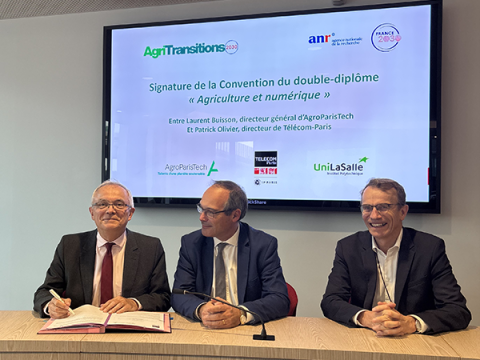
October 05 2026AgroParisTech and Télécom Paris have signed an agreement to create a joint engineering degree program. By combining their expertise, the two institutions aim to address a growing need in the agricultural sector: professionals capable of understanding the challenges of living systems and designing digital solutions tailored to real-world conditions. Structured as a four-year engineering program, the track will lead to the awarding of degrees from both schools. It will welcome its first students at the start of the 2027 academic year, with an initial target of five to ten students per class at each institution.
Dual expertise to support agricultural transformation
Climate change adaptation, resource conservation, agroecological and energy transitions, and food sovereignty: the transformations taking place in agriculture call for scientific and technical skills that transcend disciplinary boundaries. Artificial intelligence and data analysis offer opportunities to better understand agricultural systems and support decision-making. Their relevance, however, depends on knowledge of living environments, agricultural practices, and an understanding of the constraints professionals face. Advances in sensors, telecommunications, and the Internet of Things further expand the range of necessary skills. The new joint degree program addresses this need by bringing together two engineering schools. AgroParisTech contributes its expertise in agronomy, life sciences, data science, and the environment; Télécom Paris brings its expertise in digital sciences and technologies, particularly in artificial intelligence, data, and connected systems.
Laurent Buisson, Executive Director of AgroParisTech“Agricultural transitions require engineers who can understand the complexity of living systems and master the digital tools that can support them. Together with Télécom Paris, we are developing a program that will equip students with these dual skills, closely aligned with the needs of the industry. This joint degree program embodies the vision of AgriTransitions 2030: to evolve educational programs so that future professionals can drive change in the agricultural sector.”
Agronomy and data science come together to train engineers to address complex agricultural transitions
For AgroParisTech students, this joint degree program will allow them to deepen their knowledge of digital sciences and gain access to fields that go beyond the application of data science in agronomy alone, such as networks, communications, and connected devices. For Télécom Paris students, it will provide training in agricultural and environmental sciences, enabling them to apply their digital skills to concrete and complex agricultural challenges. The goal is to train engineers capable of bridging disciplines, understanding user needs, and selecting the appropriate methods for the problems they encounter.
Patrick Olivier, Director of Télécom Paris“To design digital solutions that are useful for agriculture, we must understand the systems in which they will be deployed. This joint degree program will enable our students to combine a rigorous mastery of AI, data, and digital technologies with an in-depth understanding of agronomic and environmental challenges. We want to train engineers who are capable of working with stakeholders in the life sciences sector and collaborating with them to develop solutions tailored to their needs.”
Four years of study and two engineering degrees
The program is based on reciprocal mobility between the two institutions. For the first graduating class (2027–2029), students who have completed their second year at their home institution will begin their second year at the partner school at the start of the 2027 academic year. For this first cohort, AgroParisTech students will have access to Télécom Paris’s internal programs, including its master’s degrees and specializations: digital economy and innovation, computer science and security, networks, communications, and the Internet of Things, as well as artificial intelligence and data science. Conversely, Télécom Paris students will have access to AgroParisTech’s internal programs, including, in their final year, all of AgroParisTech’s specialization tracks and its master’s programs. Starting in 2028, the final year of study will consist of a dedicated program, developed jointly by the two partner institutions, leading to the granting of both degrees.
Bringing together digital sciences and life sciences
The value of the program lies in the ability of future graduates to apply their knowledge in a coherent manner. Understanding how data is generated, recognizing its limitations, selecting an analytical method, and interpreting the results within an agricultural context are all skills that must be developed together. The complementary nature of the curriculum should enable students to engage effectively with digital specialists as well as agronomists and professionals in the agricultural sector.
Bertrand David, Director of Training at Télécom Paris“The educational challenge is to teach students to apply digital methods to agronomic problems. Knowing how to build a model or analyze data is not enough: students must also understand what they are measuring, the limitations of the available data, and the conditions under which the results can be used. The curriculum developed jointly by the two schools is designed to equip students with this ability to engage in dialogue and this rigor in designing solutions.”
The joint degree program prepares students for roles at the intersection of agriculture, the environment, and digital technologies. Potential career paths include, among others:
- Research and development engineer in the fields of agriculture and digital technology;
- Project manager for the design of decision-support tools;
- Agricultural data expert, data scientist, or data analyst;
- Consultant in agroecological and digital analysis.
These skills are designed to meet the needs of agricultural and agri-food companies, agritech stakeholders, research institutes, and organizations involved in public agricultural and environmental policy.
Focus on AgriTransitions 2030 & skills development
The joint degree program is one of the initiatives of the AgriTransitions 2030 project, which was selected through France 2030’s “Skills and Careers of the Future” call for expressions of interest. Launched on October 1, 2025, for a five-year term, the project is led by AgroParisTech, with UniLaSalle and Télécom Paris as co-leaders. Based on the findings of the “CAP Agricultures” foresight study, it supports the evolution of skills across three key areas: agroecological, energy, and digital transitions. AgriTransitions 2030 aims to contribute to the training of a growing number of learners, technicians, managers, and professionals through 18 training programs. It combines traditional initial training, apprenticeships, and continuing education, including Bachelor’s degrees in agriculture, engineering curriculum courses, online training, and initiatives for trainers. Its total budget amounts to 8.1 million euros, including 4.5 million euros in grants. The project brings together a network of academic partners, agricultural high schools, and industry stakeholders in Île-de-France, Normandy, Hauts-de-France, and Centre-Val de Loire.